Timoté
Timoté
Saving Product Managers 6.4 hours per week
Saving Product Managers 6.4 hours per week
Saving Product Managers 6.4 hours per week
Role
Lead Product Designer
Lead Product Designer
duration
March–September 2024
March–September 2024
team
Lisa Doyen UI/UX Designer
Lena Vulliez Product Manager
Pierre Clerc AI & No-code Engineer
Oscar Satre AI Engineer
Christine Cai Market Researcher
My contribution
Discovery
Ideation & Concepting
Prototype
User Testing
Discovery
Ideation & Concepting
Prototype
User Testing

Quick Overview
Quick Overview
Problem
Problem
PMs lose 6.4h/week searching for scattered information across 8+ tools
PMs lose 6.4h/week searching for scattered information across 8+ tools
Key constraint
Key constraint
Proactive AI with <10% margin for error before trust breaks
Proactive AI with <10% margin for error before trust breaks
Solution
Solution
AI that detects key moments and surfaces relevant context
AI that detects key moments and surfaces relevant context
Impact
Impact
36% less time searching, 82% relevant suggestions, 8/10 would recommend
36% less time searching, 82% relevant suggestions, 8/10 would recommend
Context
Product Managers at tech scale-ups juggle an average of 8 tools daily: Slack, Notion, Jira, Figma, Google Drive, Linear, Miro, Confluence. Information gets scattered. Decisions get lost. Teams waste hours reconstructing context.
Product Managers at tech scale-ups juggle an average of 8 tools daily: Slack, Notion, Jira, Figma, Google Drive, Linear, Miro, Confluence. Information gets scattered. Decisions get lost. Teams waste hours reconstructing context.
The cost: 6.4 hours per week per PM spent searching for information they know exists somewhere.
The cost: 6.4 hours per week per PM spent searching for information they know exists somewhere.
That's nearly a full workday, every week, lost, just looking for informations.
That's nearly a full workday, every week, lost, just looking for informations.
Discovery
Finding the Real Problem
Finding the Real Problem
We started with a hypothesis: PMs need better coordination tools between stakeholders.
We started with a hypothesis: PMs need better coordination tools between stakeholders.
I designed an interview protocol and conducted 18 in-depth interviews with Product Managers at scale-ups over 3 weeks. I expected to hear about communication breakdowns.
I designed an interview protocol and conducted 18 in-depth interviews with Product Managers at scale-ups over 3 weeks. I expected to hear about communication breakdowns.
By interview 12, a different pattern emerged.
By interview 12, a different pattern emerged.
The real problem wasn't communication, it was how information becomes invisible over time.
The real problem wasn't communication, it was how information becomes invisible over time.
“Technical informations always gets lost over time.”
— Julien, PM
“Technical informations always gets lost over time.”
— Julien, PM
PMs do document decisions. But two months later, those decisions are effectively lost:
PMs do document decisions. But two months later, those decisions are effectively lost:
Slack threads get buried under thousands of new messages
The "why" behind decisions is scattered across Notion, Jira, and Figma
Documentation becomes outdated because updating it takes 5 minutes they don't have
Slack threads get buried under thousands of new messages
The "why" behind decisions is scattered across Notion, Jira, and Figma
Documentation becomes outdated because updating it takes 5 minutes they don't have
"When it hasn't been documented at the time it was done, it's extremely difficult to go back to it later."
— Thomas, PM
"When it hasn't been documented at the time it was done, it's extremely difficult to go back to it later."
— Thomas, PM
The pivot: We stopped building a coordination tool. We needed to build a memory assistant.
The pivot: We stopped building a coordination tool. We needed to build a memory assistant.
Research Insights
What Really Matters
What Really Matters
Documentation fails because updating costs too much
Documentation fails because updating costs too much
70% of PMs struggled to maintain docs, not from laziness, but overload. Updating a Notion doc after a Slack decision takes 5 minutes they don't have.
70% of PMs struggled to maintain docs, not from laziness, but overload. Updating a Notion doc after a Slack decision takes 5 minutes they don't have.
My decision: Timoté captures context automatically. No new workflow.
My decision: Timoté captures context automatically. No new workflow.
PMs lose the "why," not just the "what"
PMs lose the "why," not just the "what"
They don't just lose time searching. They lose time reconstructing why decisions were made.
They don't just lose time searching. They lose time reconstructing why decisions were made.
My decision: Every suggestion includes what was decided, who decided it, and why (with source). Context over answers.
My decision: Every suggestion includes what was decided, who decided it, and why (with source). Context over answers.
One bad suggestion kills trust
One bad suggestion kills trust
Testing revealed: one irrelevant suggestion and users stop trusting the tool for hours.
Testing revealed: one irrelevant suggestion and users stop trusting the tool for hours.
My decision: 0.75 confidence threshold. Below that, Timoté stays silent. Max 3 suggestions/hour/channel. This became a non-negotiable design principle with engineering.
My decision: 0.75 confidence threshold. Below that, Timoté stays silent. Max 3 suggestions/hour/channel. This became a non-negotiable design principle with engineering.
Design Decisions
Where & How Timoté Appears
Where & How Timoté Appears
Decision 1: Slack integration (not standalone app)
Decision 1: Slack integration (not standalone app)
Why: 80% of PM conversations happen in Slack. A standalone app would be the 9th tool, we would only be adding to the problem.
Why: 80% of PM conversations happen in Slack. A standalone app would be the 9th tool, we would only be adding to the problem.
Tradeoff: We limit to one platform. But focus > feature sprawl.
Tradeoff: We limit to one platform. But focus > feature sprawl.
Impact: Zero friction adoption.
Impact: Zero friction adoption.
Decision 2: Repositionable popup
Decision 2: Repositionable popup
I designed three variants and A/B tested with 10 PMs:
I designed three variants and A/B tested with 10 PMs:
Sidebar: Ignored 67% of time
Notification: Felt like spam
Popup: 7/10 preferred, noticeable but dismissible
Sidebar: Ignored 67% of time
Notification: Felt like spam
Popup: 7/10 preferred, noticeable but dismissible
After testing, I added "snooze per channel" for user control.
After testing, I added "snooze per channel" for user control.
how it works
The Solution
The Solution
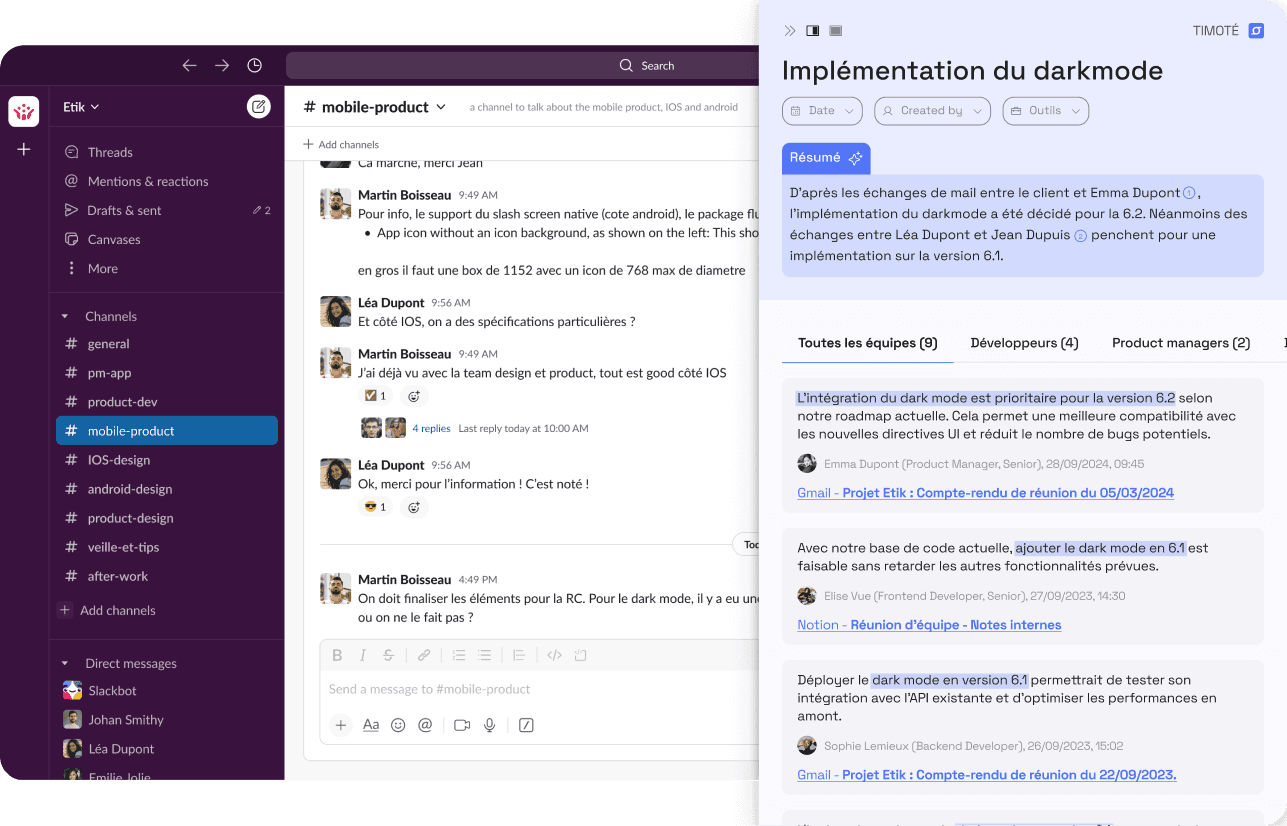
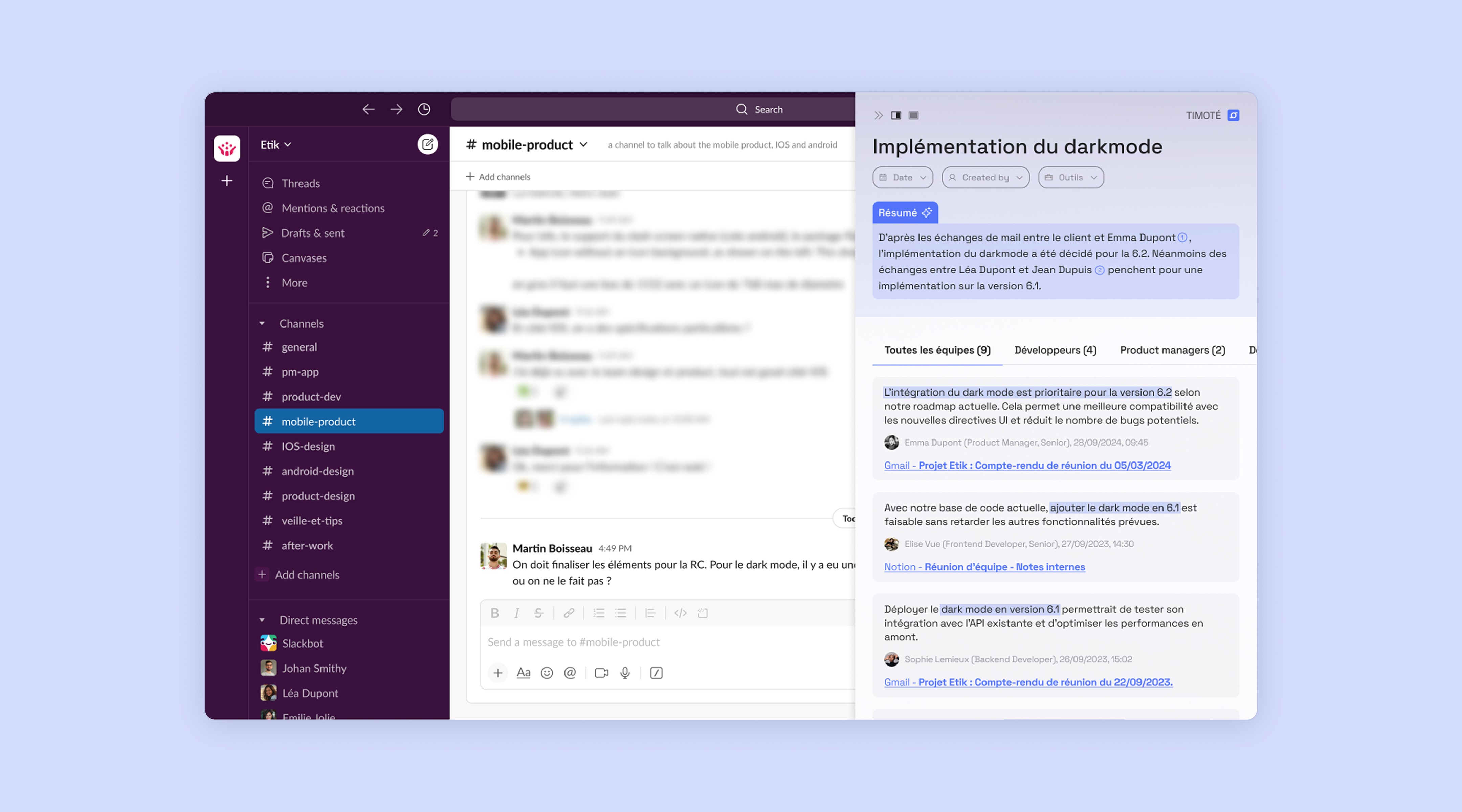
When Timoté detects a key moment - a question, debate, or contradiction - a small notification appears asking if you want context.
When Timoté detects a key moment - a question, debate, or contradiction - a small notification appears asking if you want context.
Click it, and a panel opens with structured information organized by team and role. It shows:
Click it, and a panel opens with structured information organized by team and role. It shows:
A summary at the top synthesizing the key decision
Filter tabs to view by team (all teams, developers, PMs, designers)
Individual messages with full context: who said what, their team, when, and the source (Gmail, Notion, etc.)
Clickable links to access and verify every piece of information
A summary at the top synthesizing the key decision
Filter tabs to view by team (all teams, developers, PMs, designers)
Individual messages with full context: who said what, their team, when, and the source (Gmail, Notion, etc.)
Clickable links to access and verify every piece of information
The design prioritizes verifiability, every suggestion includes attribution and sources so users can trust what they're seeing.
The design prioritizes verifiability, every suggestion includes attribution and sources so users can trust what they're seeing.
User testing
Seeing It Work
Seeing It Work
Louise, a PM at a fintech scale-up, opens Slack to find a question from her team:
Louise, a PM at a fintech scale-up, opens Slack to find a question from her team:
"Hi everyone, we need to finalize what goes in the RC. About the dark mode implementation, there seems to be confusion. What did we decide last time? Do we keep 6.1 or 6.2? Or not do it at all?"
"Hi everyone, we need to finalize what goes in the RC. About the dark mode implementation, there seems to be confusion. What did we decide last time? Do we keep 6.1 or 6.2? Or not do it at all?"
The decision was made at least 3 weeks ago, and Louise has no idea where she could find the information.
The decision was made at least 3 weeks ago, and Louise has no idea where she could find the information.
Without Timoté:
Without Timoté:
Louise looked through every possible app where the information could be stored. Gmail, Notes, Notion, Finder, Figma, Jira, and so on. Finally, she found it. But she lost so much time.
Louise looked through every possible app where the information could be stored. Gmail, Notes, Notion, Finder, Figma, Jira, and so on. Finally, she found it. But she lost so much time.
Total: 24 minutes
Total: 24 minutes
With Timoté:
With Timoté:
A notification appears: "Want to know more about dark mode implementation?"
A notification appears: "Want to know more about dark mode implementation?"
She clicks. The panel opens with a summary:
"Based on email exchanges between the client and Emma Dupont, dark mode implementation was decided for 6.2. However, discussions between Léa Dupont and Jean Dupuis lean toward implementation in version 6.1."
Below, she sees the full context organized by team, developers, PMs, designers, with timestamps, sources (Gmail, Notion), and clickable links.
Total: 30 seconds
Total: 30 seconds
The iteration that mattered
The iteration that mattered
Users liked summaries but didn't trust them.
Users liked summaries but didn't trust them.
"Where did this [information] come from?"
— Louise, PM
"Where did this [information] come from?"
— Louise, PM
Version 1:
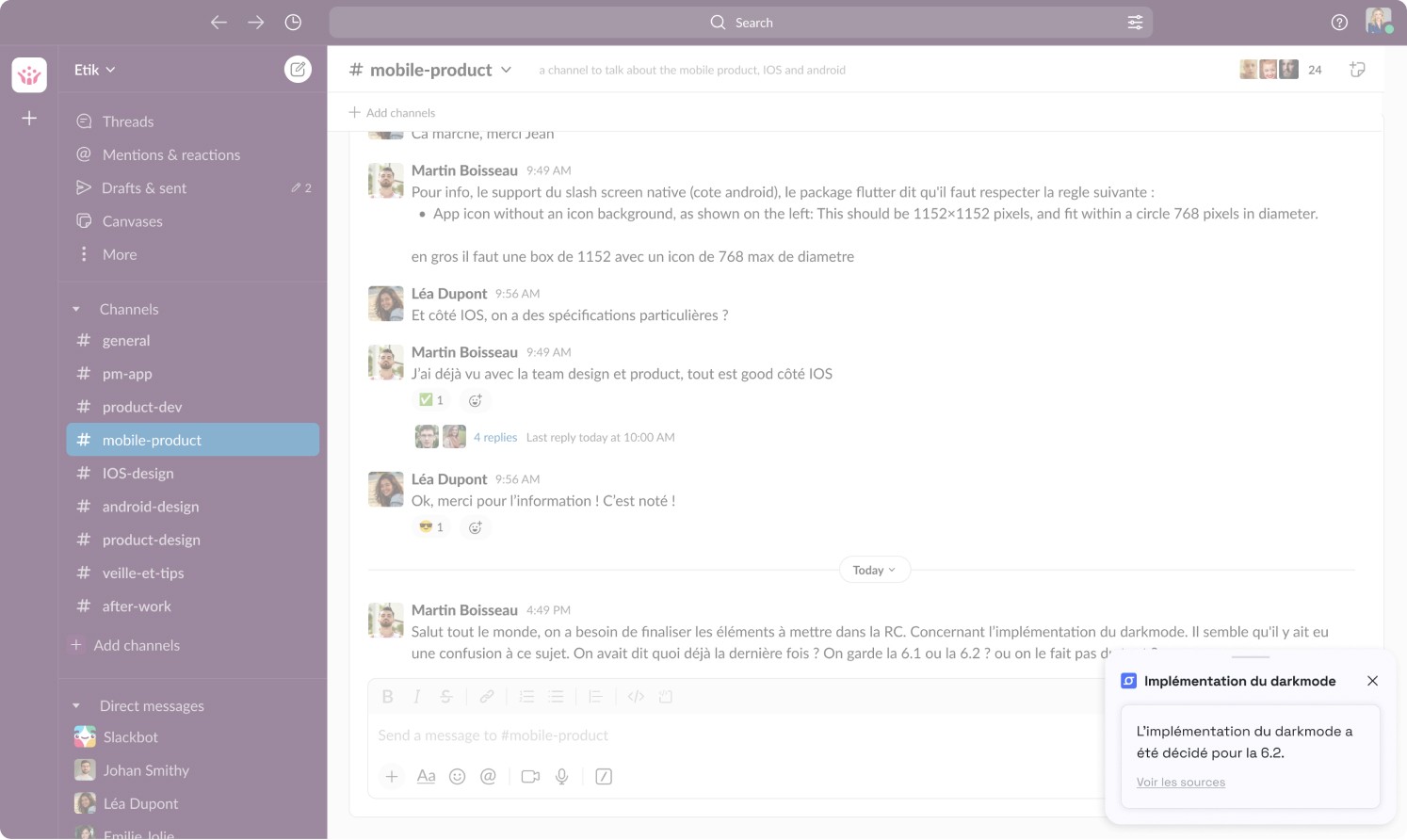
Simple explanation of the decision that was made
Version 2:
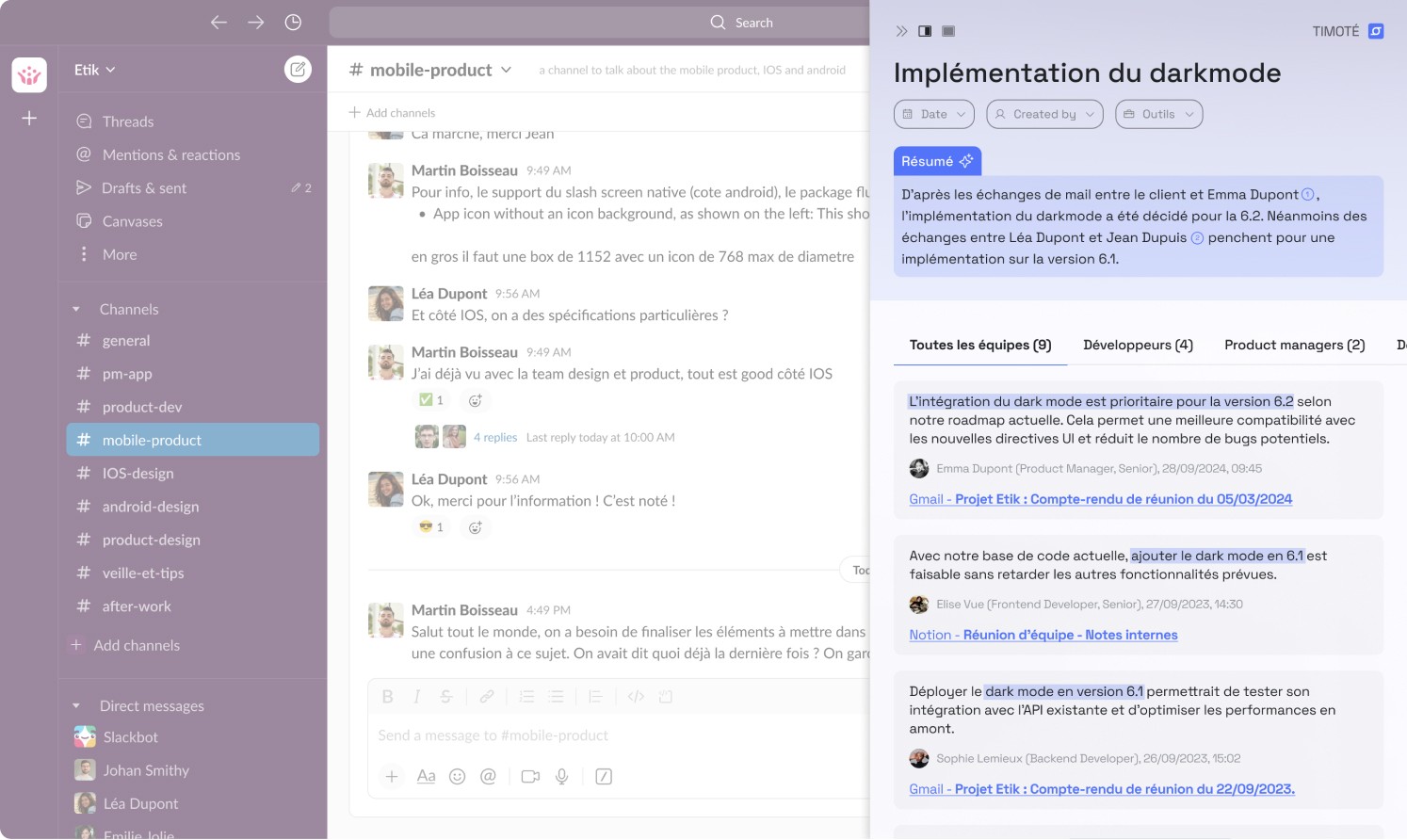
Quick summary + every mention of the decision sorted by profession for easy filtering
I added: who, when, source.
I added: who, when, source.
Impact: Trust scores doubled (3.2 → 6.8 / 10).
Impact: Trust scores doubled (3.2 → 6.8 / 10).
Why it worked: Users wanted verifiable context, not just answers.
Why it worked: Users wanted verifiable context, not just answers.
Key Outcomes
Impact & Results
reflections
What I Learned
What I Learned
What worked:
What worked:
Challenging hypothesis early saved months
Designing for trust first (0.75 threshold) was critical
Slack integration = zero friction
Challenging hypothesis early saved months
Designing for trust first (0.75 threshold) was critical
Slack integration = zero friction
What I'd do differently:
What I'd do differently:
Embed a PM user from day one, not validate at phase end
Track actual behavior, not just self-reported satisfaction
Think more about the security of the information to which Timoté has access.
Embed a PM user from day one, not validate at phase end
Track actual behavior, not just self-reported satisfaction
Think more about the security of the information to which Timoté has access.
This taught me: the best design solves the problem you discover, not the one you started with.
This taught me: the best design solves the problem you discover, not the one you started with.
We pivoted from "communication tool" to "memory assistant" because I asked better questions and listened harder.
We pivoted from "communication tool" to "memory assistant" because I asked better questions and listened harder.
Take a look at another one of my projects.
Take a look at another
one of my projects.